01 / UAV PERCEPTION
Seeing the world.
On board.
Computer vision is a different engineering problem when the model has to run on an aircraft. Accuracy matters, but so do latency, data quality, and the hardware carrying it.
The problem
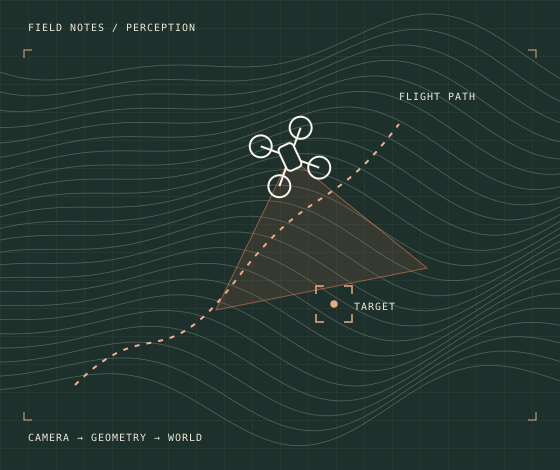
Small and distant targets, changing viewpoints, and constrained onboard compute make aerial perception challenging. A detector must be evaluated in the context of the camera stream and target hardware.
My work
At ATLAN Space, I worked on training and deploying detection and classification systems for obstacles, vehicles, people, boats, and other aerial applications. My work included OpenCV-based processing, TensorRT/ONNX inference, and deployment on Jetson Nano and Xavier AGX.
I also developed approaches using optical flow, clustering, and multi-view cues for obstacle perception and depth estimation. These themes informed my doctoral research.
Engineering decisions
- Evaluate quality and execution time together rather than selecting a model on accuracy alone.
- Compare the exported runtime with the training implementation and inspect preprocessing differences.
- Consider the full camera-to-output pipeline, including memory transfers and post-processing.
- Inspect small targets and difficult scenes explicitly, beyond aggregate metrics.
A related publication
I co-authored a study on evolutionary architecture search for boat detection in aerial imagery. The paper reports a 68% reduction in operations relative to its parent network, alongside improved mAP. That result is specific to the published study and its experimental setup.
Limits and lessons
Throughput depends on the complete deployment setup. A benchmark on one device, resolution, or dataset does not establish performance in a new environment. Public summaries here describe my work without distributing employer datasets or implementation code.