02 / PRODUCTION MACHINE LEARNING
Beyond the
notebook.
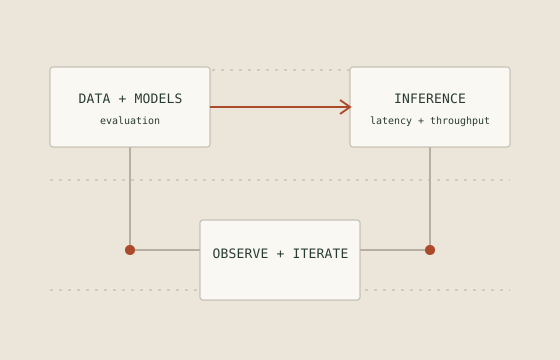
Building a useful ML system means connecting data, models, evaluation, inference, and the software that surrounds them.
The context
My previous roles at Onclusive and Onclusive Social connected model development with production engineering. The work covered multilingual NLP as well as visual brand analysis.
My contributions
At Onclusive, I worked on sentiment analysis, named-entity recognition, topic detection, keyword extraction, clustering, and summarization workflows. My engineering work included transformer model migration, tokenization and chunking, inference optimization, and AWS-based pipelines.
At Onclusive Social, I worked on logo detection and classification using YOLOv5 and ResNet50V2, alongside dataset management and model-delivery workflows.
The engineering questions
- How does a model change affect quality across languages and input lengths?
- Where is the actual latency: tokenization, inference, data movement, or downstream processing?
- What changes when inference uses quantization or another execution target?
- Can the data, model, and runtime configuration be traced and reproduced?
Tools in the work
Python, Hugging Face, PyTorch, AWS, Docker, Kubernetes, DVC, MLflow, and GitLab CI. The tool choice follows the workload, deployment constraints, and the team’s operating environment.
What I learned
Measure the system around the model and keep evaluation connected to deployment decisions. Improvements to a runtime, a model, or a preprocessing step only become useful when they fit the complete workflow.